

Exhaust-fan location can have as much influence on ventilation performance as fan capacity.
The objective is to remove unwanted air after it has passed through the area that needs ventilation.
Identify the heat sources
Start by identifying where heat is generated.
Typical sources include:
- production machinery
- furnaces
- ovens
- welding areas
- compressors
- roofs exposed to strong sunlight
- densely occupied work areas
Hot air often accumulates toward the upper part of a building, but the correct installation position depends on the building and process.
Think about the complete airflow path
A useful planning principle is:
Fresh-air inlet → working area → heat source → exhaust
The exhaust fan should not simply be installed wherever there is an available wall opening.
Avoid short-circuit airflow
One common problem occurs when an air inlet is positioned too close to an exhaust fan.
Fresh air may travel directly to the fan and leave the building without ventilating the rest of the space.
Multiple fans need coordination
When several exhaust fans are used, their locations should work together.
Fan spacing, building geometry, internal partitions and heat sources can all influence airflow.
Consider cooling as well as ventilation
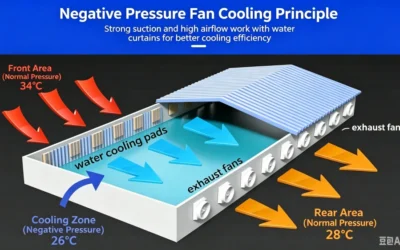
If ventilation alone cannot provide sufficient temperature reduction, exhaust fans can be combined with evaporative cooling.
The cooling system introduces cooler air while exhaust fans remove hot indoor air.
The goal is always the same:
Create a useful airflow path—not simply install more fans.
0条评论