

Industrial evaporative air coolers are not all designed for the same application.
MX Cooling offers several approaches, including fixed industrial air coolers, portable industrial air coolers and integrated evaporative air coolers.
The right choice depends on where cooling is required, how the cooled air should be delivered and the climate in which the equipment will operate.
How does evaporative cooling work?
An evaporative cooler draws outdoor air through wet cooling pads.
As water evaporates, it absorbs heat from the air.
The resulting air is cooler and is delivered into the space.
Because this process introduces moisture into the air, its effectiveness depends strongly on outdoor temperature and humidity.
1. Fixed Industrial Air Coolers
Fixed or wall-mounted air coolers are suitable when cooling is required at a defined location.
They can often be combined with an air guide or duct arrangement to direct cooled air toward the required area.
Typical applications include:
- Factories
- Workshops
- Warehouses
- Production areas
- Commercial spaces
They are particularly useful where the cooling layout is relatively permanent.
2. Portable Industrial Air Coolers
Portable units provide greater flexibility.
They can be moved according to changing cooling requirements.
They may be useful for:
- Individual workstations
- Temporary work areas
- Maintenance areas
- Specific hot zones
- Spot cooling
Instead of cooling an entire building, a portable cooler can direct airflow toward the people or areas that need it most.
3. Integrated Evaporative Air Coolers
An integrated evaporative cooler combines the fan and cooling-pad arrangement into a single unit.
This can provide a straightforward solution where a compact, self-contained evaporative cooling arrangement is preferred.
They can be particularly attractive where simplicity and direct installation are priorities.
How large should the cooler be?
Do not select an evaporative cooler based only on a stated coverage area.
Consider:
- Building dimensions
- Ceiling height
- Outdoor temperature
- Outdoor humidity
- Heat generated inside
- Number of people
- Machinery
- Required airflow
- Air-inlet and exhaust arrangements
A large factory may require multiple distributed coolers rather than one very large unit.
How important is humidity?
Very important.
Evaporative cooling depends on water evaporation.
When outdoor air is relatively dry, it can absorb more moisture and the evaporative cooling process can be more effective.
When outdoor humidity is already high, the potential cooling effect is reduced.
Therefore, climate should be considered before choosing evaporative cooling.
Direct cooling vs. distributed cooling
Direct / spot cooling
A portable cooler directs cooled air toward a particular location.
Useful for:
- Workers
- Workstations
- Temporary areas
- Specific hot zones
Distributed cooling
A fixed unit supplies cooled air toward a defined area through an air guide or duct arrangement.
Whole-space cooling and ventilation
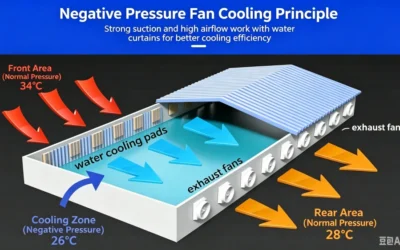
Multiple evaporative coolers can be combined with exhaust fans to establish a broader airflow system.
What about water and maintenance?
An evaporative cooler requires water.
Consider:
- Water supply
- Water quality
- Tank capacity
- Drainage
- Cooling-pad condition
- Cleaning
- Regular maintenance
Proper maintenance helps maintain consistent operation and can reduce problems caused by dirty pads or poor water management.
When should you consider something other than evaporative cooling?
Evaporative cooling may not be the best choice where:
- Outdoor humidity is consistently high
- Precise temperature control is required
- Tight humidity control is required
- The space must remain enclosed
- Refrigeration-based cooling is necessary
In these situations, industrial air conditioning may be more appropriate.
Quick selection guide
| Application | Possible choice |
| Fixed production area | Fixed Industrial Air Cooler |
| Large open factory | Multiple Fixed Air Coolers |
| Temporary cooling | Portable Air Cooler |
| Worker / workstation cooling | Portable Air Cooler |
| Simple integrated installation | Integrated Air Cooler |
| Large cooling + ventilation system | Evaporative Cooling + Exhaust Fans |
| Precise enclosed cooling | Industrial AC |
Frequently asked questions
Are evaporative coolers suitable for factories?
They can be suitable for large, open or semi-open industrial spaces when outdoor conditions are appropriate.
Can an evaporative cooler replace air conditioning?
Not in every application. Evaporative cooling is a different technology and is generally better suited to applications where fresh-air cooling and high airflow are acceptable.
Can evaporative coolers work with exhaust fans?
Yes. Combining cooled-air supply with exhaust ventilation can create a complete airflow path.
Do portable and fixed evaporative coolers serve the same purpose?
They can provide similar cooling principles but are designed for different installation and usage requirements.
Final takeaway
The right evaporative cooler depends on climate, space, airflow, installation, cooling objective and how the cooled air needs to be delivered.
Explore MX Cooling Evaporative Cooling Systems →
Explore Fixed Industrial Air Coolers →
0 Comments