

Why Enclosed Pig Houses Need Controlled Ventilation
Enclosed pig houses provide greater control over the production environment, but they also reduce the amount of natural air exchange available to the animals.
During hot weather, heat and moisture can accumulate inside the building. Poorly controlled airflow can also allow stale air and odors to remain in parts of the house.
For pigs, ventilation has two important functions:
- Bring fresh outside air into the building.
- Remove warm, humid and stale indoor air.
Good ventilation therefore requires more than installing powerful exhaust fans. The entire airflow path needs to be considered.
The Basic System: Cooling Pads → Pig House → Exhaust Fans
A common approach for hot-weather enclosed livestock buildings is tunnel-style negative-pressure ventilation.
The basic airflow arrangement is:
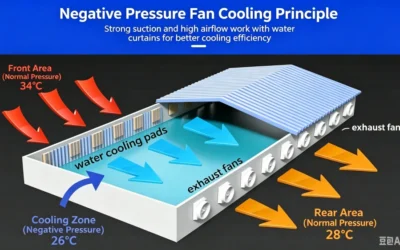
Outdoor Air → Evaporative Cooling Pads → Pig House → Negative-Pressure Exhaust Fans → Outside
The exhaust fans create the pressure difference that pulls outside air through the cooling pads and across the building.
The incoming air can be cooled as it passes through the wet evaporative media, while the exhaust fans remove warm indoor air.
This is fundamentally different from simply placing several circulation fans inside the building.
Why Natural Ventilation May Not Be Enough
Natural ventilation can be useful under suitable outdoor conditions, but its performance depends heavily on:
- Outdoor wind
- Building orientation
- Window and opening location
- Building dimensions
- Internal obstructions
- Temperature difference
- Weather conditions
During periods of high summer temperature, relying only on open windows may not provide a sufficiently predictable airflow path.
A mechanically controlled negative-pressure system gives the operator much greater control over the direction and quantity of airflow.
What Does Negative-Pressure Ventilation Do?
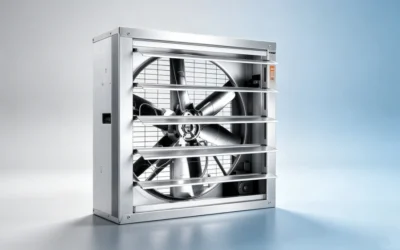
In a negative-pressure system, exhaust fans remove air from the building.
Replacement air then enters through designed openings.
The goal is to create a controlled path:
Fresh air enters → moves through the animal area → picks up heat and moisture → exits through exhaust fans
For tunnel ventilation, locating the main air inlet opposite the exhaust fans helps create airflow along the length of the building.
Poor inlet positioning can cause uneven airflow and stagnant zones rather than a uniform airflow path.
Why Add Evaporative Cooling?
Exhaust ventilation can remove heat from a pig house, but when outdoor air is already very hot, simply bringing more hot air into the building has limits.
Evaporative cooling addresses the temperature of the incoming air.
Water is distributed across the cooling pad.
As air passes through the wet pad, some water evaporates and absorbs heat from the incoming air.
The result is cooler incoming air, although the relative humidity of the air increases.
The effectiveness of evaporative cooling depends strongly on outdoor conditions, pad condition, airflow and system design.
Application Reference: 4,500 m² Enclosed Finishing Pig House
Location
Sichuan, China
Building
Approximately 4,500 m² enclosed finishing pig house.
Original Challenge
The house originally relied primarily on natural ventilation through windows.
During summer, the building experienced problems associated with:
- Heat accumulation
- Stale air
- Elevated ammonia
- Heat-stress conditions
- Reduced feed intake
Referenced System
The application used:
Evaporative Cooling Pads → Pig House → Negative-Pressure Exhaust Fans
Temperature-based control was used for the exhaust fans, while water circulation supplied the cooling pads.
Reported Results
The supplied application reference reports:
- Indoor temperature maintained at approximately 22–26°C during summer
- Improved removal of ammonia and stale air
- Reported electricity savings of approximately 30%
- Reduced heat-stress conditions
These figures should be treated as reported application results, not guaranteed MX Cooling performance.
Actual results will vary according to climate, building design, animal density, fan selection, cooling-pad performance, control settings and operating conditions.
What This Pig House Example Demonstrates
The most important lesson is that livestock cooling should be treated as a complete airflow system.
Adding more exhaust fans without considering the air inlet may not solve the problem.
Similarly, installing cooling pads without sufficient exhaust capacity will not automatically create the desired airflow.
The major components need to work together:
Air Inlet + Cooling Pads + Exhaust Fans + Controls
How to Select Exhaust Fans for an Enclosed Pig House
Before selecting fan quantity, consider:
Building dimensions
Length, width and height determine the available airflow path.
Pig capacity
Animal numbers and animal size influence ventilation requirements.
Climate
Hot and humid conditions create different design requirements from hot and dry climates.
Required airflow
Fan capacity should be considered at the actual operating condition rather than relying only on free-air airflow.
Static pressure
Cooling pads, screens, shutters, inlets and other system components create resistance.
Air inlet design
The inlet must provide sufficient area and distribute incoming air effectively.
Control requirements
A temperature-based or other automatic control strategy may be appropriate for changing conditions.
Final Takeaway
An enclosed pig house should not be treated as a simple “fan installation” project.
The objective is to create a controlled airflow path that can:
- Bring in fresh air
- Remove heat and moisture
- Reduce stagnant air
- Support air-quality management
- Provide cooling during hot conditions
For larger enclosed pig houses, negative-pressure exhaust ventilation combined with properly designed air inlets and evaporative cooling can form an integrated summer ventilation system.
0 Comments