

Evaporative cooling and industrial air conditioning can both reduce indoor temperatures, but they work in fundamentally different ways.
The right choice depends on the building, climate, humidity, cooling objective and required level of temperature control.
There is no single cooling technology that is best for every industrial or commercial application.
How does evaporative cooling work?
An evaporative cooler draws air through wet cooling pads.
As water evaporates, it absorbs heat from the air and reduces the air temperature.
The cooled air is then delivered into the space.
This is an open-air cooling process and adds moisture to the air.
Therefore, outdoor humidity is an important factor in determining performance.
How does industrial air conditioning work?
A refrigeration-based air conditioner removes heat from air through a refrigeration cycle.
Unlike evaporative cooling, it does not rely on adding evaporated water to the supply air to achieve cooling.
This makes refrigeration-based air conditioning more appropriate where:
- Precise temperature control is required
- Humidity control is important
- The space is enclosed
- Consistent cooling is required regardless of outdoor humidity
Evaporative Cooling vs. Industrial AC
| Requirement | Evaporative Cooling | Industrial AC |
| Large open spaces | Very suitable in appropriate climates | Can be more demanding |
| Fresh-air cooling | Yes | Depends on system |
| Outdoor humidity sensitivity | High | Much lower |
| Humidity control | Limited | Yes |
| Precise temperature control | Limited | Stronger |
| Spot cooling | Yes | Yes |
| Large-volume airflow | Strong | Depends on system |
| Enclosed controlled space | Less suitable | More suitable |
| Ventilation integration | Very natural | Depends on design |
When should you consider evaporative cooling?
Evaporative cooling can be attractive when:
- The space is large and open
- Fresh-air cooling is acceptable
- Outdoor conditions are suitable
- High airflow is desirable
- The objective is to improve working conditions rather than maintain a tightly controlled temperature
- Spot or directional cooling is required
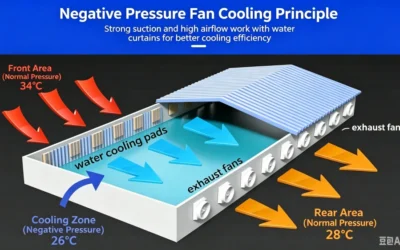
For large facilities, evaporative cooling can also be combined with exhaust ventilation.
A typical arrangement is:
Outdoor air → Evaporative cooling → Building → Exhaust fans
When should you consider industrial air conditioning?
Industrial AC becomes more attractive when:
- Temperature must be controlled
- Humidity must be controlled
- The space is enclosed
- Specific temperature conditions are required
- Outdoor humidity makes evaporative cooling less effective
- Certain equipment or processes require controlled conditions
This does not necessarily mean the entire factory needs air conditioning.
Can both technologies be used together?
Absolutely.
This can actually be a very practical strategy.
For example:
Production floor
Evaporative cooling + exhaust ventilation
Worker areas
Air circulation fans
Control room
Industrial air conditioning
Office
Air conditioning
This allows each technology to be used where it is most appropriate.
When evaporative cooling is NOT the right choice
Being honest about limitations is important.
Evaporative cooling is not automatically the best solution simply because a building is large.
It may be unsuitable when:
- Outdoor humidity is consistently high
- Precise temperature control is required
- Tight humidity control is required
- The space needs to remain enclosed
- A refrigeration-based cooling system is required
In those situations, industrial AC may be a better choice.
A simple decision guide
Large + open + suitable climate
Consider evaporative cooling.
Large + open + ventilation required
Consider evaporative cooling + exhaust fans.
Large + hot + need internal air movement
Consider cooling + circulation fans.
Enclosed + controlled temperature
Consider industrial AC.
Different requirements in different areas
Consider a combination.
Frequently asked questions
Is evaporative cooling cheaper than industrial AC?
It is not useful to compare the technologies only by purchase price. Installation, operating conditions, required cooling level and the size of the space all affect the overall economics.
Can evaporative cooling cool a factory?
Yes, when the building and climate are suitable. Large open or semi-open facilities are often natural candidates for evaporative cooling.
Can evaporative cooling work in humid climates?
Its cooling potential generally decreases as outdoor humidity increases. A site-specific assessment is therefore important.
Does industrial AC provide better temperature control?
Generally, yes. Refrigeration-based systems are better suited to applications requiring controlled temperature and humidity.
Can MX Cooling provide both?
Yes. MX Cooling’s product architecture includes evaporative cooling, industrial air conditioning, exhaust ventilation and air circulation, allowing different technologies to be considered according to the application.
Final takeaway
The decision is not simply:
“Evaporative cooler or air conditioner?”
The better question is:
“What cooling conditions does this particular building require?”
For some facilities, evaporative cooling is the practical solution.
For others, industrial AC is more appropriate.
And for many larger facilities, a combination of ventilation, evaporative cooling, air circulation and targeted air conditioning can make the most sense.
Explore MX Cooling Evaporative Cooling Systems →
Explore MX Cooling Industrial Air Conditioning →
0 Comments