

Why Summer Ventilation Matters in Layer Houses
Layer poultry houses can experience significant environmental challenges during hot weather.
High temperatures, high stocking density, humidity and insufficient airflow can create heat-stress conditions and affect production stability.
Ventilation therefore has two jobs:
Air exchange
and
Air movement
Air exchange replaces stale indoor air with fresh outside air.
Air movement helps distribute air through the poultry house and can increase the cooling effect experienced by birds.
The Basic Tunnel Ventilation Concept
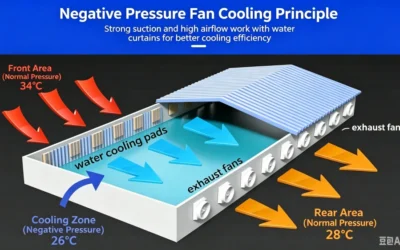
A tunnel-ventilated poultry house generally places the main air inlet at one end and exhaust fans at the opposite end.
The airflow path becomes:
Fresh Air → Poultry House → Exhaust Fans → Outside
When evaporative cooling is added:
Fresh Air → Cooling Pads → Poultry House → Exhaust Fans → Outside
The exhaust fans pull air through the cooling pads and across the poultry house.
This creates a controlled airflow direction rather than relying entirely on natural wind.
Why Airflow Distribution Matters
A poultry house can have a large exhaust fan capacity and still have areas with poor airflow.
Possible causes include:
- Poor inlet location
- Insufficient inlet area
- Internal obstructions
- Incorrect fan selection
- Excessive system resistance
- Poor cooling-pad condition
The objective is not simply to move air through the building.
The objective is to move air through the animal area in a controlled and useful way.
Why Cooling Pads Can Help
Evaporative cooling pads can reduce the temperature of incoming air when outdoor conditions are suitable for evaporative cooling.
Water flows through the pad while the exhaust fans pull air through the wet media.
Some of the water evaporates and absorbs heat from the incoming air.
The cooling effect depends on:
- Outdoor temperature
- Outdoor humidity
- Pad condition
- Air velocity
- Pad size
- Water distribution
- System design
Therefore, cooling-pad performance should be evaluated together with fan capacity rather than as an independent component.
Application Reference: Layer Poultry House in Xinjiang
Application
High-density layer poultry house.
Challenge
High summer temperatures combined with high-density housing created heat-stress risks and affected production stability.
The application reference also identifies egg damage as an operational concern.
System
The referenced system combined:
- Evaporative cooling pads
- Multiple negative-pressure exhaust fans
- Temperature sensors
- Humidity sensors
- Automatic controls
The airflow concept was:
Cooling Pads → Layer House → Negative-Pressure Exhaust Fans
Fan operation and cooling-pad water supply were adjusted according to indoor environmental conditions.
Reported Results
The supplied reference reports:
- Indoor temperature of approximately 27–28°C
- Reduced heat-stress conditions
- Improved production stability
- Fewer damaged eggs
- Reduced manual inspection through automatic operation
These are reported application figures and should not be presented as guaranteed results from MX Cooling equipment.
Why Automatic Control Can Be Useful
Poultry houses do not experience the same conditions throughout the day.
For example:
Morning → moderate ventilation requirement
Midday → increasing ventilation requirement
Afternoon → high ventilation requirement
Evening → decreasing ventilation requirement
Automatic controls can allow ventilation equipment to respond to changing conditions instead of relying entirely on manual operation.
Possible inputs include:
- Temperature
- Humidity
- Time schedule
- Fan operating status
The actual control strategy should be designed for the specific poultry house.
Exhaust Fans vs. Circulation Fans
These two types of equipment should not be confused.
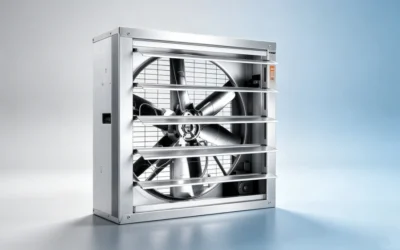
Exhaust fans
Remove air from the poultry house.
Their role includes:
- Air exchange
- Heat removal
- Moisture removal
- Removal of stale air
Circulation fans
Move air within the building.
Their role is primarily internal air movement.
A poultry house may require both functions depending on the building and ventilation design.
How to Select Poultry Exhaust Fans
Consider:
1. House dimensions
Length, width and height determine the airflow path.
2. Bird capacity
Ventilation requirements change with flock size and bird development.
3. Target airflow
Determine the required airflow under the intended operating condition.
4. Static pressure
The fan must overcome resistance from the complete ventilation system.
5. Air inlet
The inlet needs to provide sufficient airflow without creating undesirable airflow patterns.
6. Cooling-pad area
Adding fans without considering cooling-pad capacity can change system resistance and airflow performance.
7. Controls
Determine whether the system needs:
- ON/OFF operation
- Multiple fan stages
- Variable-speed fans
- Temperature control
- Humidity control
Final Takeaway
A poultry cooling system should be designed as a coordinated system:
Air Inlet + Cooling Pads + Exhaust Fans + Environmental Control
Increasing fan capacity alone does not guarantee better cooling.
The most important question is:
Can the complete system deliver the required airflow through the bird area under actual operating conditions?
0 Comments