

A fixed or ducted industrial air cooler is designed to provide evaporatively cooled air to a defined area of a factory, workshop, warehouse or commercial building.
Unlike portable air coolers that are moved from one location to another, fixed industrial air coolers are installed in a planned position and can use an air guide or duct system to direct cooled air where it is needed.
They are particularly useful when cooling needs to be relatively permanent and the airflow needs to be distributed in a controlled direction.
What is a Fixed / Ducted Industrial Air Cooler?
A fixed industrial air cooler draws outdoor air through wet cooling pads.
As the air passes through the pads, water evaporates and absorbs heat from the air. The resulting cooler air is then delivered into the building.
A typical system works like this:
Outdoor air → Cooling pads → Cooled air → Air guide / duct → Target area
Depending on the building and installation, the cooled air may be discharged directly into the space or directed through an air guide or duct arrangement.
When is a Fixed Industrial Air Cooler a good choice?
Fixed air coolers are particularly suitable when:
- Cooling is required at a permanent location
- The building has defined cooling zones
- Large volumes of fresh cooled air are desirable
- Portable equipment would be inconvenient
- Cooled air needs to be directed toward specific areas
- The cooling system can be integrated into the building layout
Typical applications include:
- Factories
- Workshops
- Warehouses
- Production facilities
- Commercial buildings
- Large work areas
- Semi-open industrial spaces
Direct discharge or ducted cooling?
One important decision is how the cooled air should be delivered.
Direct air delivery
The cooler is installed so that cooled air enters the target area directly.
This can be a relatively simple solution when the cooling area is close to the installation position.
Ducted or guided air delivery
An air guide or duct is used to direct cooled air toward a particular area.
This can be useful when:
- The cooler cannot be positioned directly beside the target area
- Several areas need controlled air delivery
- The building layout requires a specific airflow direction
- Cooling needs to be distributed through a defined route
The duct or air-guide arrangement should be considered together with the cooler rather than treated as an afterthought.
How does evaporative cooling work?
Evaporative cooling uses the natural cooling effect of water evaporation.
Outdoor air passes through wet cooling pads. As some of the water evaporates, heat is absorbed from the air, reducing its temperature.
The cooled air is then supplied to the building.
Because this is an evaporative process, outdoor humidity has an important influence on cooling performance.
In relatively hot and dry conditions, evaporative cooling can provide a substantial temperature reduction.
As outdoor humidity increases, the available evaporative cooling potential generally decreases.
Does a fixed air cooler cool the whole factory?
Not necessarily.
This is an important point when planning an industrial cooling system.
A fixed air cooler is often better understood as a cool-air supply unit, rather than assuming that one unit will automatically provide uniform cooling throughout an entire factory.
The actual result depends on:
- Building size
- Ceiling height
- Outdoor climate
- Indoor heat sources
- Airflow volume
- Cooler location
- Air-distribution arrangement
- Exhaust ventilation
- Building openings
A large facility may therefore require multiple air coolers positioned according to the building layout.
Where should the air cooler be installed?
The installation position should be selected according to the desired airflow path.
For example:
Outdoor air → Air cooler → Production area → Exhaust
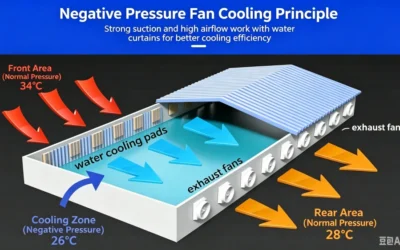
This arrangement can work particularly well when combined with negative-pressure exhaust ventilation.
The exhaust fans remove indoor air while the evaporative air coolers provide cooled replacement air.
This creates a continuous airflow path through the building.
Fixed evaporative cooling + exhaust ventilation
For larger industrial buildings, a fixed air cooler does not necessarily need to work alone.
A combined system can use:
Fixed / Ducted Industrial Air Coolers
to supply cooled air
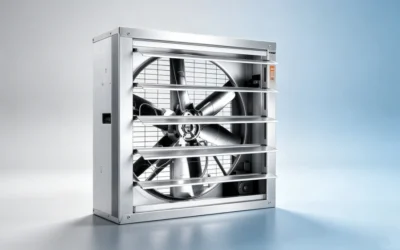
Industrial Exhaust Fans
to remove hot indoor air.
A typical airflow arrangement is:
Outdoor air → Evaporative cooler → Factory → Exhaust fan → Outside
This can be an effective approach for large, open or semi-open facilities where fresh-air cooling is appropriate.
How should you determine the required cooling capacity?
Avoid selecting equipment based only on a manufacturer’s stated coverage area.
The actual requirement depends on the application.
Important information includes:
- Building length
- Building width
- Building height
- Location and climate
- Outdoor temperature
- Outdoor humidity
- Indoor temperature
- Heat generated by machinery
- Number of workers
- Required cooling area
- Required airflow
- Existing exhaust ventilation
- Available installation locations
A supplier can use this information to determine a more appropriate equipment arrangement.
Should the cooler use ducting?
Ducting is not automatically required.
Direct discharge may be suitable when:
- The target area is close to the cooler
- The building is relatively open
- A simple installation is preferred
- The cooled air can be discharged directly toward the working area
Ducted or guided delivery may be useful when:
- The target area is further away
- Air needs to follow a defined route
- Cooling needs to be directed into specific zones
- The building layout makes direct discharge impractical
The objective is not to use more ducting.
The objective is to deliver cooled air where it provides the most useful result.
Fixed vs. Portable Industrial Air Coolers
Fixed and portable evaporative coolers solve different installation problems.
| Fixed / Ducted Air Cooler | Portable Air Cooler | |
|---|---|---|
| Installation | Permanent | Movable |
| Cooling location | Planned area | Flexible |
| Air distribution | Direct or ducted | Usually directional |
| Best for | Permanent cooling zones | Spot / temporary cooling |
| Building integration | Higher | Lower |
| Relocation | Limited | Easy |
| Typical use | Factory / production area | Workstation / hot spot |
If cooling requirements change frequently, portable equipment may be more convenient.
If the cooling requirement is permanent and predictable, a fixed installation can provide a more organized solution.
When is evaporative cooling not the best choice?
Evaporative cooling is not suitable for every application.
Consider another cooling technology when:
- Outdoor humidity is consistently high
- Precise temperature control is required
- Tight humidity control is required
- The space must remain enclosed
- Refrigeration-based cooling is required
For enclosed or temperature-sensitive areas, industrial air conditioning may be more appropriate.
Frequently Asked Questions
What is a fixed industrial air cooler?
A fixed industrial air cooler is a permanently installed evaporative cooling unit designed to supply cooled outdoor air to a defined area of a building.
What is a ducted industrial air cooler?
A ducted industrial air cooler uses an air guide or duct arrangement to direct cooled air from the evaporative cooler toward a specific area or zone.
Can a fixed industrial air cooler cool a factory?
Yes, but the required number and arrangement of units depend on the building size, climate, heat load, airflow requirements and desired cooling areas.
Does a fixed air cooler need an exhaust fan?
Not always, but exhaust fans can be an important part of a larger evaporative cooling and ventilation system. They can remove hot indoor air while the evaporative coolers supply cooled outdoor air.
Can a fixed air cooler replace industrial AC?
Not in every application. Evaporative cooling is particularly suited to large, open or semi-open spaces where fresh-air cooling is acceptable. Industrial AC is generally more appropriate where precise temperature or humidity control is required.
Is ducting always necessary?
No. Some installations can discharge cooled air directly into the target area. Ducting or air guides become useful when cooled air needs to be directed over a particular route or into specific zones.
Choosing the Right Fixed Industrial Air Cooler
The best fixed industrial air cooler is not necessarily the largest unit.
The system should be selected according to:
Building → Climate → Heat load → Airflow → Cooling zones → Air distribution → Ventilation
For a larger factory, the best solution may combine several fixed air coolers with industrial exhaust fans rather than relying on one large cooling unit.
If you can provide your building dimensions, location, photos, floor plan and cooling requirements, MX Cooling can help determine a suitable cooling arrangement.
Explore Fixed / Ducted Industrial Air Coolers →
Explore Evaporative Cooling Systems →
0条评论