

An evaporative air cooler can be running normally, moving a large volume of air, and still fail to provide the cooling effect a factory expects.
This does not necessarily mean the cooler is defective. Evaporative cooling depends on several factors working together, including outdoor temperature, humidity, water evaporation, cooling-pad condition, airflow and building ventilation.
Understanding these factors is important before replacing equipment or assuming that a larger cooler is always the answer.
1. Outdoor Humidity Matters
Evaporative cooling works by allowing water to evaporate into the passing air. The evaporation process absorbs heat from the air.
When outdoor air is hot and relatively dry, it has greater capacity to accept additional moisture, so evaporative cooling can be effective.
When outdoor humidity is already high, less water can evaporate and the achievable temperature reduction becomes smaller.
This is why the same air cooler can produce different results in different climates or on different days.
2. Cooling-Pad Condition Matters
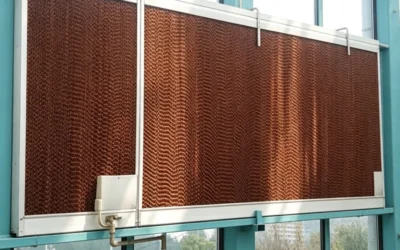
The cooling pad is where much of the air-water contact occurs.
A pad that is:
• clogged with dust
• covered with mineral deposits
• damaged
• poorly wetted
• unevenly supplied with water may reduce cooling performance.
Simply increasing fan speed cannot necessarily compensate for a cooling pad that is not working properly.
3. Airflow Is Only Part of the Equation
A cooler may have a high rated airflow, but the cooled air still needs to reach the occupied area.
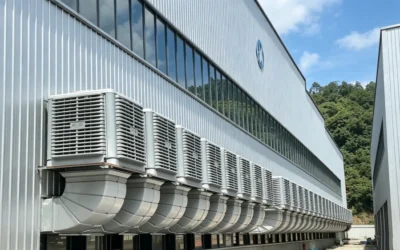
Building height, ducting, air outlet position, internal obstructions and air distribution can all affect the result.
A cooler that produces cold air near its outlet is not necessarily providing effective cooling throughout a large workshop.
4. Exhaust and Air Replacement Are Important
An evaporative cooler adds cooled air to the building.
That air needs somewhere to go.
If hot indoor air is not removed effectively, the cooling system may struggle to maintain the desired environment.
This is why evaporative cooling and industrial ventilation should often be considered as one system rather than two independent products.
5. Check the Whole System Before Replacing the Cooler
When an evaporative cooler appears to be underperforming, check:
• outdoor temperature
• relative humidity
• cooling-pad condition
• water distribution
• airflow
• ducting
• air outlet position
• exhaust capacity
• building openings
• actual operating conditions
The most effective solution may be a change in airflow distribution or ventilation rather than simply installing a larger cooler.
Final Takeaway
Evaporative cooling performance depends on the interaction between the cooler, air, water and building. The right question is therefore not simply:
“How powerful is the cooler?”A better question is:
“Is the entire cooling and ventilation system allowing the cooler to work effectively?”MX Cooling provides evaporative cooling and industrial ventilation solutions for different building configurations and applications.
0 Comments