

Negative pressure ventilation is a simple and effective way to control airflow through a large building.
In simple terms, exhaust fans remove air from the building, creating a slight pressure difference that draws replacement air in through designated openings.
The objective is not to create a vacuum.
The objective is to establish a controlled direction of airflow.
What is negative pressure ventilation?
When exhaust fans remove air from a building, the indoor air pressure becomes slightly lower than the outdoor pressure.
Outdoor air then enters through available or designed openings.
The basic airflow path is:
Fresh outdoor air → Building → Exhaust fan → Outside
This principle is used in many factories, warehouses, agricultural buildings and other large spaces.
Why use negative pressure ventilation?
A negative-pressure ventilation system can help remove:
- Hot air
- Humid air
- Stale air
- Odors
- Heat generated by machinery
- Process-related air
- Certain airborne contaminants where appropriate
It can also provide continuous air exchange when properly designed.
What happens if there isn’t enough air inlet?
This is one of the most important—and frequently overlooked—parts of the system.
If exhaust fans attempt to remove a large volume of air but there is insufficient replacement air entering the building, airflow can become restricted.
The fan may still operate, but the overall ventilation system may not deliver the expected performance.
Therefore:
Exhaust capacity and air-inlet capacity should be considered together.
Where should replacement air enter?
Ideally, incoming air should travel through the area requiring ventilation before reaching the exhaust fans.
For example:
Fresh-air inlet → Production area → Hot-air zone → Exhaust fan
The exact arrangement depends on the building.
The objective is to avoid short-circuiting the airflow, where incoming air immediately exits without properly ventilating the space.
Negative pressure vs. air circulation
These two concepts are often confused.
An exhaust fan removes air from the building.
An air circulation fan moves air within the building.
A circulation fan can improve internal air movement and comfort, but it does not replace an exhaust fan when the objective is air exchange or removal of accumulated hot air.
Can negative pressure ventilation provide cooling?
It can help reduce indoor heat, particularly when outdoor conditions are cooler than the accumulated indoor air.
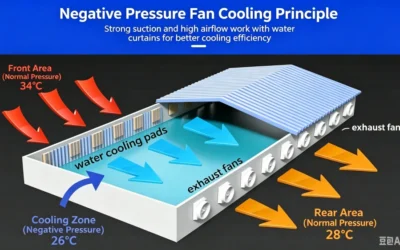
For stronger cooling, exhaust fans can be combined with evaporative cooling.
A typical arrangement is:
Outdoor air → Cooling pads → Cooled air enters building → Hot air exits through exhaust fans
This creates a combined evaporative cooling + negative-pressure ventilation system.
Negative-pressure ventilation applications
The approach can be used in:
- Factories
- Workshops
- Warehouses
- Agricultural buildings
- Poultry houses
- Livestock facilities
- Greenhouses
- Commercial buildings
- Other large spaces requiring high-volume air exchange
Common design mistakes
Installing exhaust fans without considering air inlets
The fan needs a suitable source of replacement air.
Choosing fans only by maximum airflow
Actual airflow depends on operating conditions and system resistance.
Positioning inlets and exhausts too close together
This can create an inefficient airflow path.
Assuming ventilation and circulation are the same
They solve different problems.
Trying to cool every building with ventilation alone
In hot conditions, ventilation may need to be combined with evaporative cooling or mechanical air conditioning.
Frequently asked questions
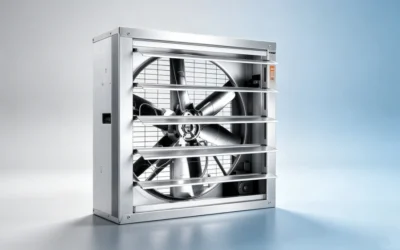
What is a negative-pressure exhaust fan?
It is an exhaust fan used to remove air from a building and create a slight pressure difference that encourages replacement air to enter through designated openings.
Can negative pressure ventilation cool a factory?
It can help remove accumulated hot air. For stronger cooling, it can be combined with evaporative cooling or other cooling technologies.
Do negative-pressure systems need air inlets?
Yes. The replacement-air path is an important part of the overall ventilation system.
Is an exhaust fan the same as a circulation fan?
No. An exhaust fan removes air from the building, while a circulation fan primarily moves air within the building.
The key idea
Negative-pressure ventilation is not simply about installing exhaust fans.
It is about controlling the direction and movement of air through the building.
Explore MX Cooling Negative Pressure Exhaust Fans →
Explore Industrial Ventilation Solutions →
Ask MX Cooling About Your Building →
0 Comments