

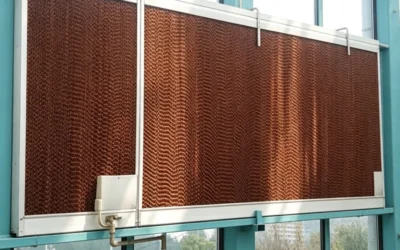
The cooling pad is one of the most important components in an evaporative cooling system.
Its job is to provide a large wet surface through which incoming air can pass.
Why the pad matters
Water needs to evaporate into the passing air.
A properly designed pad provides sufficient contact between:
air + water + pad surface
The source material explains that evaporation area affects evaporation efficiency and describes water being distributed across the pad before returning to the sump.
Bigger isn’t automatically better
Increasing pad size can increase available contact area, but the system still needs to balance:
- airflow
- pad thickness
- air velocity
- water distribution
- pressure drop
- pump capacity
- cooling demand
A pad that is too small may provide insufficient contact area.
A system that is excessively restrictive can create unnecessary resistance and reduce airflow.
Pad quality also matters
Important factors include:
- material construction
- corrugation
- thickness
- wetting uniformity
- water distribution
- cleanliness
- maintenance
Keep the pad clean
Dust and mineral deposits can reduce effective airflow and water distribution.
Regular inspection and appropriate maintenance are therefore important.
Think of the pad as part of the system
Cooling performance depends on more than the pad alone.
It depends on the relationship between:
Pad → Water → Airflow → Fan → Building
That’s why cooling-pad selection should be considered as part of the complete evaporative cooling system.
0 Comments