

Heat stress can have a significant impact on dairy cattle. When temperatures and humidity rise, cattle have more difficulty releasing body heat, which can affect feed intake, comfort, health and milk production. Good ventilation and effective cooling are therefore important parts of managing hot-weather conditions in dairy facilities.
One practical approach is to combine evaporative cooling pads with large exhaust fans. This fan-and-pad system introduces cooler outdoor air into the barn while continuously removing warm, humid air.
How Does Evaporative Cooling Work in a Dairy Barn?
In a typical system, outside air enters the building through a bank of wetted evaporative cooling pads.
As air passes through the wet pad surface, some of the water evaporates. The evaporation process removes heat from the incoming air, reducing its dry-bulb temperature while increasing its moisture content.
Large exhaust fans installed on the opposite side of the barn then draw this cooled air through the facility.
The basic airflow is:
Outdoor Air → Cooling Pads → Cooled Air → Livestock Area → Exhaust Fans → Outside
This arrangement can create a continuous airflow pattern through the barn and is commonly associated with tunnel ventilation systems.
Why Exhaust Fans Are Just as Important as the Cooling Pads
Cooling pads alone do not create the required airflow.
The exhaust fans provide the air movement that pulls outdoor air through the wet pads and carries heat and moisture out of the barn.
For this reason, the cooling system should be considered as a complete ventilation and cooling system, rather than treating the pads and fans as independent products.
Fan selection should consider:
- Building dimensions
- Required airflow
- Air inlet and outlet arrangement
- Pad size and thickness
- Static pressure
- Local climate
- Heat load from the animals and building
A poorly designed airflow path can reduce the effectiveness of the entire system.
Climate Matters
Evaporative cooling is generally most effective when outdoor air is hot and relatively dry.
The reason is simple: dry air has greater capacity to absorb additional moisture. As outdoor humidity increases, the potential for evaporative cooling decreases.
This is one of the most important considerations when evaluating a cooling-pad system.
Hot + relatively dry climate → strong evaporative cooling potential
Hot + humid climate → reduced evaporative cooling potential
Evaporative cooling also increases the humidity of the incoming air, so the ventilation system must be designed to provide adequate air exchange.
For high-temperature and high-humidity locations, other cooling approaches may need to be considered depending on the facility and livestock conditions.
Choosing the Right Cooling Pads
Cooling pads are available in different materials, thicknesses and designs.
The appropriate pad depends on factors including:
- Local climate
- Required airflow
- Available installation area
- Pad thickness
- Air velocity through the pad
- Water quality
- Fan capacity
Thicker pads can provide greater contact between the air and wetted surface, but they can also create greater airflow resistance. The pad and fan system therefore need to be considered together.
Keep the Pads Clean
Dust, dirt, mineral deposits and biological growth can restrict airflow and reduce cooling performance.
Regular inspection and cleaning are important, particularly in livestock buildings where dust levels can be high.
Water quality also matters. Hard water or water containing significant mineral content can cause deposits on the pad surface and water-distribution components.
A suitable maintenance program should include:
- Regular pad inspection
- Cleaning when required
- Checking water distribution
- Monitoring water quality
- Removing mineral buildup
- Inspecting pumps and circulation systems
Exhaust Fan Maintenance Matters Too
The exhaust fans are responsible for moving the large volume of air required by the system.
Keep fan shutters, guards, blades and housings clean and free from unnecessary obstructions.
For belt-driven fans, belts should also be inspected regularly for proper tension and wear. A slipping or poorly maintained belt can reduce fan performance and increase operating losses.
Regular fan maintenance helps maintain the airflow that the cooling-pad system depends on.
Tunnel Ventilation for Dairy Barns
A common arrangement places the cooling pads at one end of a long barn and the exhaust fans at the opposite end.
The fans draw outdoor air through the cooling pads and create a continuous airflow along the length of the building.
This is known as tunnel ventilation.
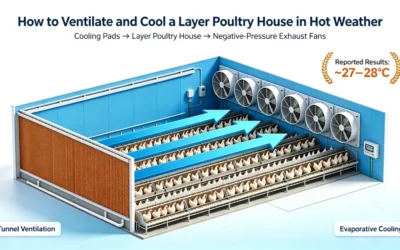
Tunnel ventilation has been used extensively in poultry housing and has also been adopted for larger dairy facilities.
The exact arrangement depends on the building geometry, ventilation requirements and local climate.
Cooling Pads + Exhaust Fans: One System, Not Two
A successful evaporative cooling installation depends on the interaction between the cooling pads, fans, air inlets, building layout and environmental conditions.
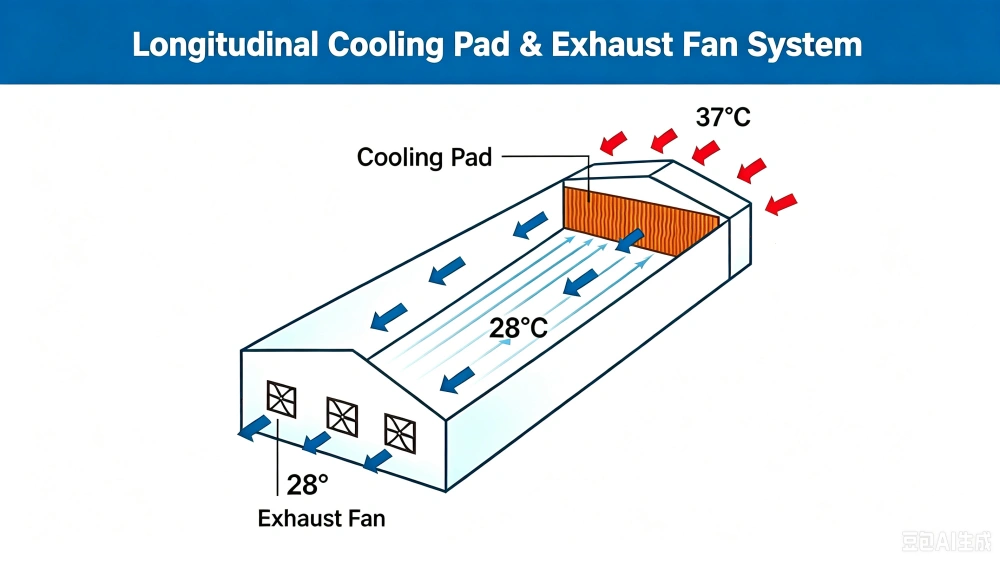
The basic concept is:
1. Outdoor air enters through the cooling pads
↓
2. Water evaporation reduces incoming air temperature
↓
3. Large exhaust fans pull the air through the barn
↓
4. Air movement helps remove accumulated heat
↓
5. Warm and humid air is exhausted outside
The result is a continuous flow of fresh, cooled air through the livestock area.
Is Evaporative Cooling Right for Your Dairy Barn?
Before selecting equipment, consider:
- Is your summer climate hot enough to require additional cooling?
- Is outdoor humidity generally low enough for effective evaporative cooling?
- What are the dimensions and volume of the barn?
- Where can cooling pads and exhaust fans be installed?
- What airflow is required?
- How much cooling-pad area is available?
- What is the expected maintenance and water requirement?
Evaporative cooling can be an effective tool for reducing heat stress when the climate and ventilation system are suitable, but it should be designed as a complete airflow system rather than simply adding cooling pads to an existing building. Research on dairy facilities confirms that pad cooling and tunnel ventilation can reduce indoor temperature, while also increasing indoor relative humidity, making system design and climate assessment important.
MX Cooling Fan & Pad Solutions
MX Cooling supplies equipment for integrated industrial and agricultural cooling and ventilation systems, including negative pressure exhaust fans and evaporative cooling pads.
For a dairy barn or livestock facility, the appropriate combination depends on building size, climate, ventilation requirements and operating conditions.
Need help planning your ventilation and cooling system?
Send us your building dimensions, application and location. Our team can help identify a suitable preliminary configuration.
0 Comments