

Exhaust Ventilation and Air Circulation Are Not the Same
One of the most common misunderstandings in livestock ventilation is assuming that every fan performs the same job.
It does not.
A negative-pressure exhaust fan and an air circulation fan have different functions.
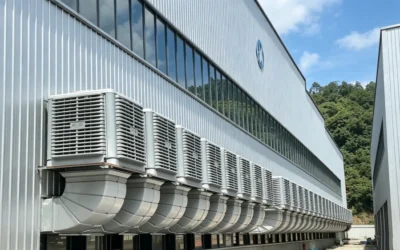
Exhaust fan
Moves air out of the building.
Air circulation fan
Moves air around inside the building.
A livestock building can therefore benefit from both.
What Does a Negative-Pressure Exhaust Fan Do?
An exhaust fan removes air from the pig house.
As air is exhausted, replacement air enters through designed openings.
The overall airflow becomes:
Fresh Air → Pig House → Exhaust Fan → Outside
The system is designed to exchange indoor air with outdoor air.
This helps manage:
- Heat
- Moisture
- Stale air
- Odors
- Air contaminants
Good ventilation also requires appropriate air inlet design.
What Does an Air Circulation Fan Do?
An air circulation fan does not primarily exchange indoor air with outside air.
Instead, it moves air within the building.
For example:
HVLS Fan → Internal Air Movement
The objective is to reduce stagnant areas and improve air movement throughout the animal area.
Large-diameter, low-speed fans can move substantial volumes of air across large spaces while operating at relatively low air speeds.
Why Use Both?
Consider a large pig house.
An exhaust fan may be successfully removing air from one end of the building.
However, some areas inside the house may still have weaker air movement.
An internal circulation fan can help distribute air within those areas.
The two systems therefore solve different problems.
Exhaust ventilation
Air exchange
Air circulation
Air distribution
A good livestock airflow system may need both.
Application Reference: Pig Farm Ventilation Retrofit in Xuzhou
Application
Multiple pig houses within a livestock farm.
Challenge
Hot air accumulated in the upper areas of the buildings.
Ammonia and humidity also remained trapped in areas with insufficient air movement.
Referenced Solution
The system combined:
Negative-Pressure Exhaust Fans + Permanent-Magnet HVLS Fans
The exhaust fans provided rapid air extraction.
The HVLS fans provided internal air circulation.
System Concept
HVLS Air Circulation
↓
Pig House
↓
Negative-Pressure Exhaust Fans → Outside
Reported Results
The supplied application reference reports:
- Summer indoor temperature reduction of approximately 3–4°C
- Ammonia reduction from approximately 28 ppm to below 9 ppm
- Improved daily weight gain
- Lower reported mortality
These are reported third-party application figures and should not be presented as guaranteed results from MX Cooling equipment.
Actual performance depends on building configuration, animal density, climate, fan capacity, inlet arrangement, operating strategy and other factors.
Why More Exhaust Fans Are Not Always the Complete Answer
Suppose a farm already has significant exhaust capacity.
If some areas remain stagnant, the first question should not automatically be:
“Do we need more exhaust fans?”
The problem may instead involve air distribution.
Possible causes include:
- Poor inlet location
- Building obstructions
- Uneven airflow
- Insufficient internal circulation
- Incorrect fan positioning
This is why ventilation should be separated into two questions:
Question 1
How do we exchange indoor air?
Exhaust ventilation.
Question 2
How do we distribute and circulate air inside the building?
Air circulation.
Exhaust Fans and HVLS Fans Can Complement Each Other
A combined system might operate like this:
Fresh air enters
↓
HVLS fans distribute and circulate air
↓
Warm/stale air moves toward exhaust points
↓
Negative-pressure exhaust fans remove air
↓
Outside
The actual airflow pattern depends on building design and fan placement.
The objective is to avoid creating a system where fans simply fight each other or move air without improving the overall ventilation path.
When Should a Pig Farm Consider HVLS Fans?
HVLS or other circulation fans may be worth evaluating when:
- The building is large
- Stagnant zones are present
- Internal air movement is poor
- Exhaust ventilation already exists
- Additional air movement is needed around the animals
- Heat stress is an important concern
However, circulation fans should not be treated as a replacement for required air exchange.
What Should Be Evaluated Before Adding Fans?
Existing exhaust capacity
How much air is actually being removed?
Air inlet arrangement
Where is replacement air entering?
Fan location
Where are the strongest and weakest airflow areas?
Building geometry
Partitions, walls, equipment and animal housing can influence airflow.
Animal location
Air movement should be evaluated where the animals actually spend time.
Air quality
Temperature, humidity and ammonia measurements can help identify problem areas.
Final Takeaway
The most important distinction is:
Exhaust fans exchange air. Air circulation fans move air inside the building.
They can therefore complement each other rather than compete with each other.
For large livestock facilities, evaluating both air exchange and air distribution can provide a much clearer picture of the actual ventilation problem.
0 Comments