

Large factories and warehouses often face the same basic problem:
Heat enters or is generated inside the building faster than it can be removed.
Machinery, production processes, people, lighting, solar heat and outdoor temperatures can all contribute to uncomfortable conditions.
The solution is rarely simply “install a bigger fan.”
A better approach is to design the airflow and cooling strategy together.
Step 1: Understand the building and heat sources
Before choosing equipment, consider:
- Building dimensions
- Ceiling height
- Location and climate
- Machinery and production processes
- Heat generated inside
- Humidity
- Number of workers
- Areas requiring cooling
- Existing ventilation openings
The same equipment will not necessarily be suitable for every factory.
Step 2: Establish an airflow path
A basic ventilation strategy is:
Fresh air enters → air moves through the building → hot/stale air exits
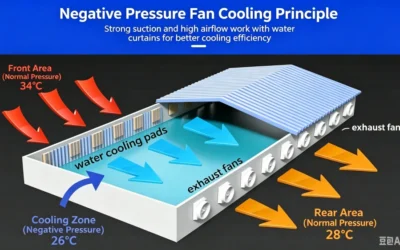
Exhaust fans are often installed on the opposite side of the building from the main air-inlet area.
The objective is to encourage air to travel through the working area rather than simply moving in and out near the same location.
Step 3: Use exhaust fans for heat removal
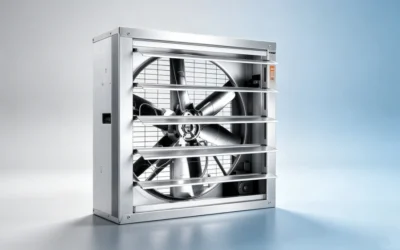
Negative-pressure exhaust fans can remove accumulated hot and humid air.
They are particularly useful for large spaces where complete mechanical air conditioning would be impractical or unnecessary.
Fan selection should consider required airflow and system resistance rather than floor area alone.
Step 4: Add evaporative cooling when conditions are suitable
If ventilation alone is insufficient, evaporative cooling can provide cooled fresh air.
A common arrangement is:
Outdoor air → Cooling pads → Cooled air → Factory → Exhaust fans
This approach can be attractive for large, relatively open facilities where fresh-air cooling is acceptable.
However, evaporative cooling depends on outdoor humidity. Its effectiveness generally decreases as humidity rises.
Step 5: Use circulation fans for internal air movement
Even with good ventilation, some parts of a large building may have weak air movement.
Hanging fans, industrial drum fans and HVLS ceiling fans can help distribute air.
Remember:
Exhaust fans remove air. Circulation fans move air.
They can complement each other but should not be treated as interchangeable.
Step 6: Use industrial AC where controlled cooling is needed
It may not make sense to mechanically air condition an entire factory.
Some areas may require more controlled cooling, such as:
- Control rooms
- Offices
- Inspection areas
- Security rooms
- Enclosed work areas
- Specific production zones
In these cases, industrial air conditioning can be used for targeted cooling while ventilation or evaporative cooling serves the larger space.
Three practical system configurations
1. Ventilation only
Exhaust fans
Suitable when the main objective is heat removal and air exchange.
2. Evaporative cooling + ventilation
Evaporative cooling + exhaust fans
Suitable when fresh-air cooling is appropriate for the climate and application.
3. Mixed cooling strategy
Ventilation + evaporative cooling + circulation + targeted AC
Useful where different areas of the facility have different cooling requirements.
Why one solution may not fit the entire building
A factory can have several different environments under one roof.
For example:
Production floor
Large-volume ventilation + evaporative cooling
Worker area
Circulation fans
Control room
Industrial AC
Heat-generating process area
Dedicated exhaust
This approach can be more practical than attempting to use one technology everywhere.
Information to prepare before selecting equipment
A supplier will usually benefit from:
- Building dimensions
- Location
- Building photos
- Floor plan
- Indoor temperature
- Humidity
- Heat sources
- Number of workers
- Desired indoor conditions
- Existing ventilation
- Available electrical supply
A simple building drawing and photographs can often provide more useful information than simply stating the building’s floor area.
Final takeaway
The best factory or warehouse cooling strategy is often not one product.
It is a combination of ventilation, cooling and air movement technologies matched to different parts of the building.
Explore MX Cooling Industrial Ventilation →
Explore Evaporative Cooling Systems →
0 Comments