

Exhaust fans and air circulation fans both move air, but they perform different jobs.
The simplest distinction is:
An exhaust fan removes air from a building. An air circulation fan moves air within the building.
Understanding this difference can help when planning ventilation and cooling for factories, warehouses, agricultural buildings and commercial spaces.
What does an exhaust fan do?
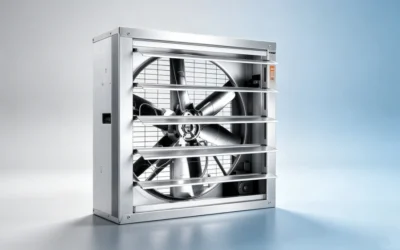
An exhaust fan removes indoor air.
Depending on the application, this can help remove:
- Heat
- Humidity
- Stale air
- Odors
- Process-related air
- Certain airborne contaminants
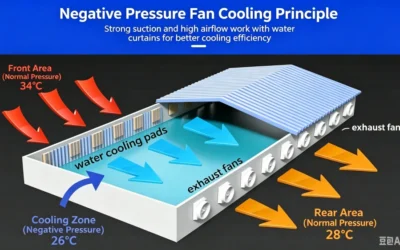
In a negative-pressure system, the removed air is replaced by outdoor air.
This creates air exchange.
What does an air circulation fan do?
An air circulation fan primarily moves existing air within a space.
It can help:
- Improve internal air movement
- Reduce stagnant areas
- Distribute cooled air
- Improve perceived comfort
- Mix air in large spaces
- Improve airflow around work areas
It does not normally provide the same air-exchange function as an exhaust fan.
Quick comparison
| Exhaust Fan | Air Circulation Fan | |
| Primary purpose | Remove air | Move air |
| Air exchange | Yes | No |
| Removes accumulated hot air | Yes | No |
| Improves internal air movement | Limited | Yes |
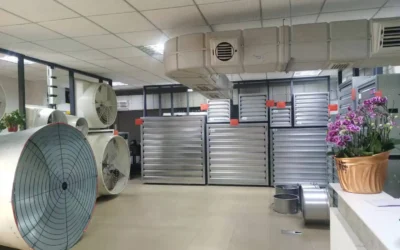
| Typical location | Wall / roof / exhaust opening | Ceiling / hanging / floor |
| Typical application | Ventilation | Cooling / circulation |
Can circulation fans replace exhaust fans?
Generally, no.
A circulation fan may make people feel more comfortable because moving air increases the perceived cooling effect.
But it does not remove hot air from the building.
Likewise, adding more exhaust fans may not solve stagnant areas inside a large facility.
The two types can therefore complement one another.
Can you use both?
Yes.
A large factory might use:
Exhaust fans
to remove accumulated hot air
Circulation fans
to distribute and move air within the working area.
This can provide a more complete airflow strategy.
Where does evaporative cooling fit?
Evaporative cooling introduces cooled outdoor air into the building.
A larger system could therefore use:
to cool incoming air,
to establish the airflow path,
to improve internal distribution.
Each component performs a different job.
What about HVLS fans?
HVLS ceiling fans are another form of air circulation equipment.
They are designed to move large volumes of air over a broad area and can be useful in large factories, warehouses, agricultural buildings and commercial spaces.
However, an HVLS fan is still primarily an air movement device, not a replacement for an exhaust ventilation system.
Which fan should you choose?
Ask one simple question:
Do you need to remove air from the building?
Consider an exhaust fan.
Do you mainly need to move air around?
Consider an air circulation fan.
Do you need both?
A combination may be appropriate.
Frequently asked questions
Can an exhaust fan cool a factory?
It can help remove accumulated hot air and improve air exchange. The actual cooling effect depends on outdoor conditions and the overall airflow design.
Can an air circulation fan cool people?
Moving air can improve perceived comfort, particularly when combined with other cooling methods.
Can exhaust fans and circulation fans work together?
Yes. They can perform complementary roles within the same facility.
Is an HVLS fan an exhaust fan?
No. HVLS fans primarily circulate air within the building.
Final takeaway
The question is not:
“Which fan is better?”
The better question is:
“What do I need the airflow to accomplish?”
That determines whether you need exhaust, circulation or a combination.
Explore MX Cooling Industrial Exhaust Fans →
0 Comments