

Choosing an industrial exhaust fan is not simply a matter of selecting the largest fan or the highest advertised airflow.
The right fan depends on the building, the purpose of ventilation, the required airflow, system resistance, installation conditions and the environment in which the fan will operate.
For factories, warehouses, agricultural buildings and commercial spaces, the goal should be to create the right airflow through the building, not simply to install a powerful fan.
What is an industrial exhaust fan?
An industrial exhaust fan removes air from a building or enclosed space.
Depending on the application, it can help remove:
Excess heat
Humidity
Stale air
Odors
Process-generated air
Certain airborne contaminants
Accumulated hot air near the roof
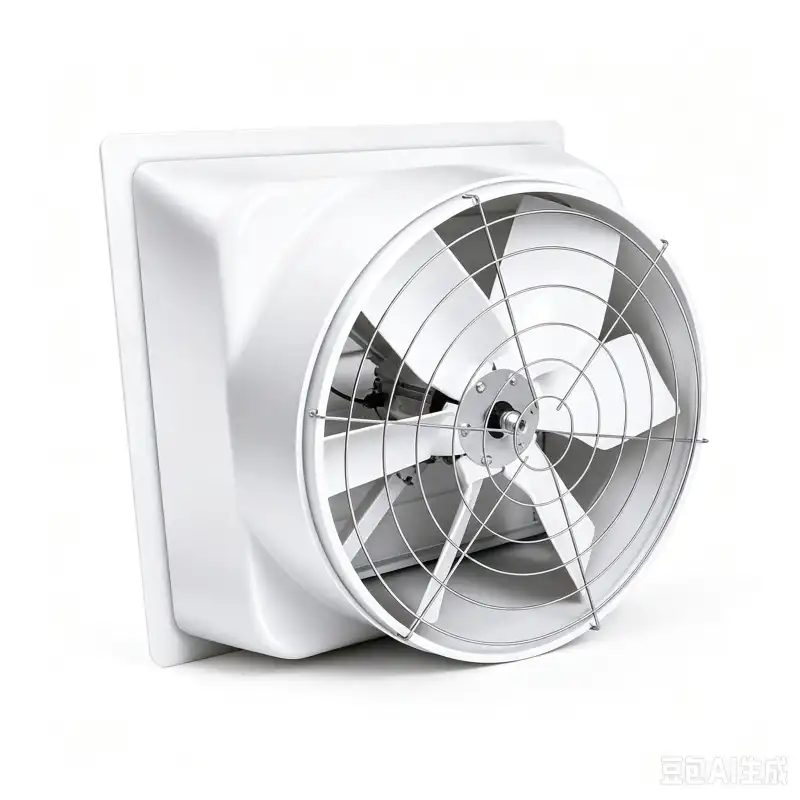
Large axial exhaust fans are commonly used for high-volume ventilation because they can move substantial quantities of air with relatively low resistance.
1. Start with the ventilation objective
Before selecting a fan, determine what you are trying to accomplish.
For example:
General ventilation
Remove stale indoor air and introduce replacement outdoor air.
Heat removal
Remove hot air generated by machinery, production processes or solar heat.
Agricultural ventilation
Provide air exchange for livestock, poultry or other agricultural environments.
Humidity and odor control
Remove moisture, odors or unwanted air from the building.
Negative-pressure ventilation
Create a controlled airflow path through the building.
The application affects the fan configuration, size and installation arrangement.
2. Determine the required airflow
Airflow is one of the first specifications to consider.
Important information includes:
Building length
Building width
Building height
Required air-change rate
Indoor heat load
Number of occupants or animals
Heat and moisture generated by production
Outdoor climate
Desired ventilation conditions
However, building size alone is not enough to select a fan.
Two factories with the same floor area may require very different ventilation systems because their heat loads, production processes, climates and air-inlet arrangements are different.
3. Airflow is not the whole story
One of the most important points when comparing industrial exhaust fans is the difference between maximum airflow and actual operating airflow.
A fan may have a high airflow rating under relatively low-resistance conditions.
Once the fan operates against resistance from:
Shutters
Louvers
Ducts
Filters
Screens
Other ventilation equipment
the delivered airflow may be lower.
For this reason, fan selection should consider airflow together with static pressure and the actual installation conditions.
For a simple wall-mounted exhaust application, resistance may be relatively low.
A ducted system requires more attention to pressure requirements.
A useful question to ask your supplier
Instead of asking only:
“What is the maximum airflow?”
also ask:
“What airflow can the fan deliver under my actual operating conditions?”
4. Consider the complete airflow path
An exhaust fan works as part of a ventilation system.
A simple negative-pressure arrangement is:
Outdoor air → Air inlet → Building → Exhaust fan → Outside
If the building does not have an adequate path for replacement air, the exhaust system may not perform as intended.
This is why air inlets and exhaust fans should be considered together.
The location of the air inlet also matters. Ideally, incoming air should travel through the area requiring ventilation before reaching the exhaust side.
5. Choose the appropriate fan configuration
Industrial exhaust fans are available in different configurations.
Standard Exhaust Fans
For general industrial, agricultural and commercial ventilation applications.
Heavy-Duty / Large-Size Exhaust Fans
For applications requiring high-volume ventilation or larger fan dimensions.
Push-Pull Exhaust Fans
For applications requiring a different shutter-opening and closing configuration.
Direct-Drive Exhaust Fans
For applications where direct motor-drive construction is preferred.
BLDC / Variable-Speed Fans
For applications requiring flexible airflow control and adjustable operating speed.
Fiberglass / FRP Exhaust Fans
For environments where corrosion resistance is particularly important.
Stainless Steel Exhaust Fans
For applications requiring stainless-steel construction.
The most suitable configuration depends on the application—not simply on which fan has the most features.
6. Consider the operating environment
Ask what the fan will actually be exposed to.
Is the environment:
Humid?
Dusty?
Corrosive?
Agricultural?
High temperature?
Chemically aggressive?
Material selection can then become important.
A galvanized steel fan may be appropriate for many general applications, while FRP/fiberglass or stainless steel may be more suitable for particular environments.
7. Consider long-term operation
For an industrial facility, the purchase price is only one consideration.
Also consider:
Motor configuration
Drive arrangement
Shutter construction
Blade construction
Corrosion protection
Cleaning requirements
Maintenance access
Replacement parts
Operating hours
A fan that is easy to inspect and maintain can be particularly valuable in facilities where ventilation operates for long periods.
What information should you give a fan supplier?
If you want a supplier to recommend a suitable fan, provide:
Building dimensions
Application
Location
Indoor temperature and humidity
Ventilation objective
Installation position
Available installation dimensions
Electrical supply
Desired airflow, if known
Special environmental requirements
Photos, floor plans and simple building drawings can also be useful.
Final takeaway
The right industrial exhaust fan is the one that matches the required airflow, system resistance, environment and application.
It is not necessarily the fan with the largest motor or highest advertised airflow.
Explore MX Cooling Industrial Exhaust Fans
Explore Negative Pressure Exhaust Fans
0 Comments