
Discover Expert Solutions
Frequently Asked Questions
Find practical answers about industrial ventilation, exhaust fans, air circulation, evaporative cooling, industrial air conditioning, product selection and purchasing from MX Cooling.
Explore Our FAQ Categories
Industrial Ventilation FAQ
Find answers to common questions about our products and services, tailored to meet your specific needs.
What is industrial ventilation?
Industrial ventilation is the controlled movement and exchange of air within a building to remove heat, humidity, odors, stale air or other unwanted conditions and introduce or distribute fresh air.
What is negative pressure ventilation?
Negative pressure ventilation uses exhaust fans to remove air from a building. As indoor air is exhausted, replacement air enters through designed openings, creating a continuous airflow path through the building.
How does a negative pressure exhaust fan work?
The exhaust fan removes air from the building, while fresh air enters through doors, windows, louvers, cooling pads or dedicated air inlets. Proper fan and inlet arrangement creates the desired airflow through the space.
What is the difference between an exhaust fan and an air circulation fan?
An exhaust fan is designed primarily to move air out of a building. An air circulation fan primarily moves air within the building to improve air distribution and comfort.
How do I choose the right industrial exhaust fan?
Consider the building size, application, required airflow, installation location, environmental conditions, electrical supply and desired ventilation method. For project selection, providing building dimensions and application details is helpful.
How many exhaust fans does my building need?
There is no universal number. Fan quantity depends on building volume, required air exchange, fan airflow, heat load, air-inlet design and application. A system should be evaluated as a whole rather than selecting fans only by floor area.
What information should I provide when asking for an exhaust fan recommendation?
Useful information includes building length, width and height, application, location, desired ventilation objective, existing ventilation equipment and electrical supply. Photos or a building layout can also help.
Can industrial exhaust fans be used in warehouses?
Yes. Exhaust fans can be used to improve air exchange and help remove accumulated heat and stale air from warehouses. Fan arrangement should be matched to the building layout and ventilation requirements.
Can exhaust fans be used in factories?
Yes. They can be used to remove heat, stale air and other unwanted air conditions. The appropriate system depends on the manufacturing process, heat sources, building structure and ventilation requirements.
Do exhaust fans need air inlets?
Yes. When air is exhausted from a building, replacement air needs a suitable path to enter. Poorly designed or insufficient air inlets can restrict airflow and reduce ventilation effectiveness.
Industrial Exhaust Fans FAQ
Find answers to common questions about our products and services, tailored to meet your specific needs.
What is a negative pressure exhaust fan?
A negative pressure exhaust fan removes air from a building and creates a pressure difference that draws replacement air into the space. It is commonly used for large-space ventilation.
What is the difference between a standard exhaust fan and a heavy-duty exhaust fan?
The distinction generally relates to construction, size, materials, motor configuration and intended operating conditions. The appropriate choice depends on the application and required duty rather than simply the fan’s name.
What is a push-pull exhaust fan?
A push-pull exhaust fan uses a particular shutter-opening and closing arrangement designed for its intended operating configuration. It can be considered when the application requires this type of shutter mechanism.
What is a direct-drive exhaust fan?
A direct-drive exhaust fan connects the motor directly to the fan assembly rather than using a separate belt-and-pulley transmission. This can simplify the drive arrangement, depending on the specific design.
What is a BLDC fan?
A BLDC fan uses a brushless DC motor. Depending on the product design and controller, BLDC technology can support variable-speed operation and flexible airflow control.
What is a roof exhaust fan?
A roof exhaust fan is installed on or through a building roof to exhaust indoor air directly outdoors. It can be useful where roof-level heat or stale-air removal is part of the ventilation strategy.
What is an EC fan?
An EC fan uses an electronically commutated motor with electronic control. EC technology can support efficient motor operation and variable-speed control when these functions are included in the specific product.
When should I choose a fiberglass / FRP exhaust fan?
FRP fans can be considered where corrosion resistance is an important requirement. Selection should consider the specific chemicals, humidity, temperature and environmental exposure of the application.
When should I choose a stainless steel exhaust fan?
201 and 304 are different stainless-steel grades with different alloy compositions and corrosion-resistance characteristics. 304 generally offers better corrosion resistance, while 201 can be considered for applications where the environmental requirements are less demanding.
For demanding or corrosive environments, the appropriate grade should be selected based on the actual operating conditions.
What is the difference between 201 and 304 stainless steel?
Yes. They can be used to remove heat, stale air and other unwanted air conditions. The appropriate system depends on the manufacturing process, heat sources, building structure and ventilation requirements.
What are fan shutters and louvers?
A shutter or louver is the opening/closing structure associated with the fan’s air outlet. It helps control the opening when the fan operates and can help close the opening when the fan is stopped.
Why are fan shutters important?
The shutter design affects airflow, sealing, durability and the way the fan operates when starting and stopping. Construction and material selection should therefore be considered when comparing exhaust fans.
Air Circulation Fans FAQ
Find answers to common questions about our products and services, tailored to meet your specific needs.
What is an industrial air circulation fan?
An industrial air circulation fan moves and distributes air within a building rather than primarily exhausting it outdoors. It can help improve airflow distribution and reduce stagnant areas.
What is the difference between an air circulation fan and an exhaust fan?
An exhaust fan removes indoor air from the building. A circulation fan mainly moves air around inside the building. They can sometimes be used together as part of a complete ventilation or cooling system.
What is an industrial and commercial drum / barrel fan?
A drum or barrel fan is a portable fan designed to deliver strong directional airflow. It can be useful in factories, warehouses, workshops, commercial spaces and other locations requiring movable airflow.
What is the difference between a drum fan and an exhaust fan?
A drum fan primarily circulates air within a space, while an exhaust fan is designed to remove indoor air. Choose a drum fan for portable or directional airflow and an exhaust fan when air exchange is the primary objective.
When should I choose a portable drum / barrel fan?
Choose one when you need movable, directional airflow—for example, to target a particular workstation, production area or temporary work zone. Its portability makes it useful where permanent fan installation is unnecessary or impractical.
What is the difference between an air circulation fan and a drum fan?
Both circulate air, but they have different physical configurations and airflow applications. A drum fan is typically portable and directional, while circulation fans may be hanging, wall-mounted or designed for broader air distribution.
What is a hanging fan?
A hanging fan is suspended from a suitable structure and is designed to circulate air through a defined area. It can be useful where floor space is limited or where elevated air movement is preferred.
What is a livestock / cow hanging fan?
It is a hanging air circulation fan designed for livestock environments, where air movement can help improve ventilation and thermal comfort around animals. Fan selection should consider the building, animal type and environmental conditions.
What is an HVLS fan?
HVLS stands for High Volume Low Speed. HVLS fans use large-diameter blades to move a large volume of air at relatively low rotational speed, making them suitable for many large open spaces.
What is the difference between an HVLS fan and a conventional industrial fan?
HVLS fans use a large-diameter, low-speed design to distribute air across a broad area. Conventional industrial fans are available in many configurations and may provide more localized or directional airflow.
Evaporative Cooling FAQ
Find answers to common questions about our products and services, tailored to meet your specific needs.
What is evaporative cooling?
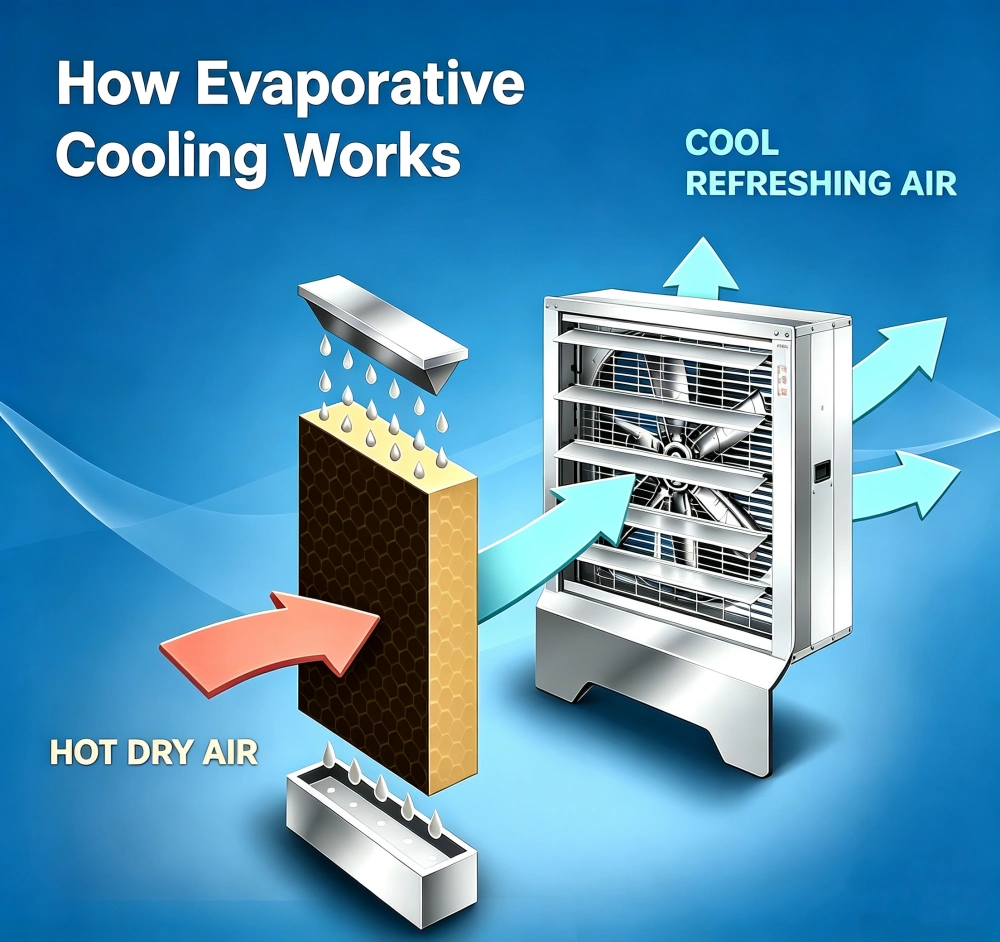
Evaporative cooling uses the evaporation of water to remove heat from air. Warm air passes through a wetted cooling medium, and evaporation lowers the temperature of the air.
How does an industrial evaporative air cooler work?
The cooler draws warm air through wet cooling pads. As water evaporates into the airflow, heat is removed and the cooled air is delivered into the target space.
What is the difference between an evaporative air cooler and an air conditioner?
An evaporative cooler uses water evaporation to cool air, while an air conditioner uses a refrigeration cycle. Evaporative cooling works particularly well where outdoor air is hot and relatively dry.
Can evaporative coolers work in humid climates?
They can operate in humid climates, but cooling effectiveness generally decreases as humidity increases because the air has less capacity to absorb additional moisture. Climate and application conditions should therefore be considered before selection.
Do evaporative coolers add moisture to the air?
Yes. Evaporative cooling transfers water into the airstream through evaporation, so the supplied air generally has higher humidity.
Do evaporative coolers require ventilation?
Yes, in most open-space industrial applications. Cooled air needs a path through the building, while warm or humid air needs to leave through exhaust fans or suitable openings.
Can an evaporative cooler replace an air conditioner?
Not in every application. The two technologies work differently and have different environmental requirements. Evaporative cooling is particularly suitable for appropriate hot and relatively dry conditions where fresh-air cooling is acceptable.
What is the difference between a fixed and portable industrial air cooler?
A fixed air cooler is installed in a designated position and may supply air through a duct or air guide. A portable air cooler can be moved between locations and is useful for spot or directional cooling.
What is an integrated evaporative air cooler?
It is a compact unit integrating the fan, cooling pads, water system and other components into one cooling unit. It provides cooled air directly from the unit.
Can exhaust fans and cooling pads be used together?
Yes. This is a common system approach for negative-pressure evaporative cooling: cooling pads provide cooled incoming air while exhaust fans remove warm air from the building.
When should I choose evaporative cooling?
Consider evaporative cooling when you want fresh-air cooling, the climate is suitable for evaporation, and some increase in indoor humidity is acceptable. Building layout and ventilation should also support the system.
Industrial & Commercial Air Conditioners FAQ
Find answers to common questions about our products and services, tailored to meet your specific needs.
What is an industrial and commercial air conditioner?
It is an air-conditioning system designed for larger or more demanding spaces than typical residential applications. Depending on the product design, it can be used in industrial, commercial and other large-space environments.
What is the difference between an industrial air conditioner and an evaporative air cooler?
An industrial air conditioner uses refrigeration to cool air, while an evaporative cooler uses water evaporation. Air conditioning provides a different type of temperature control and is less dependent on outdoor humidity.
When should I choose an industrial air conditioner instead of an evaporative air cooler?
Consider an industrial air conditioner when more controlled refrigerated cooling is required or when humidity conditions are not suitable for effective evaporative cooling. The right choice depends on climate, application and required indoor conditions.
Can an industrial air conditioner be used in commercial spaces?
Yes, depending on the product capacity, installation arrangement and cooling requirements. Potential applications include restaurants, workshops, commercial areas and other large spaces.
Can an industrial air conditioner be used for spot cooling?
Yes. Mobile or portable industrial air conditioners can be used where cooling needs to be concentrated in a particular work area rather than throughout an entire building.
What is the difference between a portable industrial air conditioner and a conventional air conditioner?
A portable industrial air conditioner is designed to be installed and used with greater flexibility, often allowing cooling to be moved between areas. Conventional systems are generally designed as more permanent installations.
How do I choose the right industrial air conditioner?
Consider the space size, heat load, indoor conditions, application, required cooling capacity, power supply and installation arrangement. For project selection, provide building dimensions and application details.
Find answers to common questions about our products and services, tailored to meet your specific needs.
Which industrial cooling or ventilation product do I need?
Start with the job you want the equipment to perform:
- Remove hot or stale air → Exhaust Fan
- Move air around → Air Circulation Fan
- Provide portable directional airflow → Drum / Barrel Fan
- Cool fresh incoming air → Evaporative Air Cooler
- Provide refrigerated cooling → Industrial Air Conditioner
For larger projects, a combination of products may be appropriate.
What information do I need to provide to select a product?
Provide the application, building dimensions, location/climate, desired cooling or ventilation objective, electrical supply and any special environmental conditions. Photos, drawings and existing equipment information are also useful.
How do I calculate the required airflow?
Required airflow depends on factors such as building volume, desired air exchange, heat generation and application. Fan selection should consider the complete airflow path rather than simply choosing a fan based on building size.
Does a larger fan always provide better ventilation?
No. Effective ventilation depends on fan airflow, air-inlet capacity, fan placement, building layout and the intended airflow path. Simply choosing the largest fan does not necessarily produce the best system.
What is airflow?
Airflow is the volume of air moved by a fan over a given period. It is one of the key factors used to evaluate and select ventilation equipment.
What is air exchange rate?
Air exchange rate describes how frequently the air inside a space is replaced by incoming and outgoing air. Required air exchange varies by building type, application and environmental conditions.
Why is building size important when selecting ventilation equipment?
Building dimensions determine the amount of air contained within the space and influence the airflow required for the desired air exchange. Building height and layout are also important.
How does building layout affect fan selection?
Walls, doors, windows, equipment, partitions, air inlets and heat sources all affect how air moves through a building. Fan location and airflow direction should therefore be considered as part of the system design.
How does climate affect cooling-system selection?
Climate influences the effectiveness of evaporative cooling, the cooling load of the building and the suitability of different technologies. Local temperature and humidity are particularly important when comparing evaporative and refrigerated cooling.
Should I choose an exhaust fan, circulation fan, evaporative cooler or air conditioner?
Choose according to the primary objective rather than the product name. If you need to remove air, consider exhaust ventilation; if you need to move air, consider circulation fans; if you need fresh-air evaporative cooling, consider evaporative coolers; and if you need refrigerated cooling, consider industrial air conditioning.
Can different MX Cooling products be used together?
Yes. Depending on the application, exhaust fans, circulation fans, evaporative coolers and air conditioners can form part of a broader cooling or ventilation system. The equipment should be selected as a coordinated system.
Applications & Solutions FAQ
Find answers to common questions about our products and services, tailored to meet your specific needs.
What ventilation solution is suitable for a factory?
There is no single solution for every factory. Depending on heat generation, processes, building structure and climate, a factory may use exhaust fans, air circulation fans, evaporative cooling, air conditioning or a combination.
What ventilation solution is suitable for a warehouse?
Warehouses often benefit from effective air movement and heat removal. Depending on the building and climate, exhaust fans, circulation fans, evaporative coolers or combinations may be considered.
Can industrial cooling systems be used in commercial buildings?
Yes. Some industrial cooling and ventilation equipment can also be suitable for commercial spaces such as restaurants, workshops, retail areas and other large or open environments.
Can these systems be used in poultry and livestock buildings?
Yes. Ventilation and cooling are important in livestock environments. Exhaust fans, circulation fans and evaporative cooling systems may be combined according to the building, climate and animal-management requirements.
Can evaporative cooling be used in greenhouses?
Yes. Evaporative cooling can be incorporated into greenhouse climate-management systems where local climate and ventilation conditions are suitable.
Can exhaust fans and cooling pads be used together?
Yes. Cooling pads can provide cooled incoming air while exhaust fans remove warm air, creating a negative-pressure evaporative cooling system.
Can drum fans be used in warehouses?
Yes. Portable drum fans can provide directional airflow in warehouse work areas, loading zones and other spaces where movable air circulation is useful.
Can industrial air conditioners be used in restaurants and commercial spaces?
Depending on the model and cooling requirements, yes. Industrial/commercial air-conditioning equipment can be considered for larger or open commercial spaces where appropriate cooling capacity is required.
Can MX Cooling provide a complete cooling and ventilation solution?
MX Cooling offers multiple categories of cooling and ventilation equipment. For project requirements, customers can provide building and application information so suitable products and configurations can be discussed.
Technical & System Design FAQ
Find answers to common questions about our products and services, tailored to meet your specific needs.
Where should exhaust fans be installed?
Placement depends on the building layout, heat sources, air-inlet locations and desired airflow path. In general, the objective is to create a deliberate path for air to enter, move through the space and exit.
Do exhaust fans need air inlets?
Yes. Exhausted air must be replaced by incoming air. Properly sized and positioned air inlets help the exhaust fans operate effectively.
What happens if there are not enough air inlets?
Restricted air entry can increase resistance and reduce the amount of air the exhaust fans can move. This can make the ventilation system less effective.
Can exhaust fans and air conditioners be used together?
Yes, but they should be considered together during system design. Excessive exhaust can remove conditioned air and increase the cooling load.
Can exhaust fans and evaporative coolers be used together?
Yes. This combination can create a fresh-air evaporative cooling system, with cooled air entering through the cooling media and warm air leaving through exhaust fans.
How should airflow move through a building?
Ideally, air should enter through planned openings, travel through the occupied or heat-generating area and exit through exhaust points. The exact arrangement depends on the building and application.
What factors affect fan performance?
Fan performance can be affected by fan design, airflow resistance, installation arrangement, air-inlet conditions, ducting where applicable, environmental conditions and operating conditions.
What is static pressure?
Static pressure is the resistance a fan must overcome while moving air through a system. It becomes particularly important when air must pass through restrictions such as ducts, filters, louvers or other components.
When does static pressure matter?
Static pressure matters whenever airflow encounters meaningful resistance. For open-wall exhaust applications it may be less significant than in ducted or highly restricted systems, but it should still be considered during engineering selection.
Why should fan selection consider the actual application rather than fan size alone?
Two fans with the same physical size can have different airflow, pressure characteristics, motor configurations and operating performance. The correct selection depends on the required operating conditions, not just dimensions.
Product Information & Catalogs FAQ
Find answers to common questions about our products and services, tailored to meet your specific needs.
Where can I find detailed product specifications?
Product pages provide an overview of the product family and its applications. Detailed model, size and specification information can be provided through the relevant MX Cooling product catalog.
Where can I find product dimensions?
Dimensions and model-specific information are provided in the relevant product documentation or catalog. Contact MX Cooling if you need information for a specific model.
Where can I download the MX Cooling product catalog?
Use the catalog download option provided on the relevant product or product-family page. If you cannot find the appropriate catalog, contact MX Cooling.
Why are some product specifications provided in the catalog rather than on the website?
Many MX Cooling product families include multiple sizes, motor configurations and technical options. The catalog provides a more practical way to present the complete range without making product pages unnecessarily complicated.
Can I request additional technical information?
Yes. Contact MX Cooling and specify the product, model or application you are interested in. Additional information can then be discussed according to the requirement.
Can MX Cooling provide drawings or technical documents?
Availability depends on the product and project. Contact MX Cooling with the model or application requirements to request the relevant documentation.
Can I request information for a specific model or size?
Yes. Provide the product type, desired size or model where known, quantity and application. This helps the team identify the relevant information.
OEM & Custom Solutions FAQ
Find answers to common questions about our products and services, tailored to meet your specific needs.
Does MX Cooling provide OEM services?
MX Cooling supports OEM and customized manufacturing requirements, including private labeling, packaging and product modifications, depending on the project.
Can products be customized?
Some products can be customized depending on the design, quantity and technical requirements. Discuss your requirements with MX Cooling before assuming a particular modification is available.
Can fan materials or configurations be customized?
Certain materials and configurations may be available depending on the product family. Requirements should be reviewed individually based on the operating environment and production feasibility.
Can motor specifications be adapted for different markets?
Motor and electrical configurations can vary by product and market. Provide the destination market, voltage, frequency, phase and other known requirements when requesting a quotation.
Does MX Cooling provide on-site measurement or installation?
MX Cooling is a ventilation and cooling equipment manufacturer. We do not provide on-site measurement, installation or commissioning services. However, customers can provide building dimensions, application details, operating conditions, drawings or photos, and our team can recommend suitable product types, models and estimated quantities based on the information provided. Installation and site-specific engineering should be handled by the customer or a qualified local contractor.
What information should I provide for a customized requirement?
Provide the application, product type, required dimensions, materials, electrical requirements, quantity, destination market and any drawings, photos or existing-product references available.
Ordering & Inquiries FAQ
Find answers to common questions about our products and services, tailored to meet your specific needs.
How can I request a quotation?
Contact MX Cooling through the website inquiry/contact form or email and provide the product, quantity, application and destination information.
What information should I include in a quotation request?
Include the product type, quantity, required size or configuration, destination country, electrical requirements and application. For ventilation projects, building dimensions and layout information are particularly useful.
Can I request a product catalog?
Yes. Product catalogs are available for relevant product ranges. You can also contact MX Cooling if you need a specific catalog or model information.
Can I order different fan sizes in one project?
This depends on the project and order requirements. Provide the required quantities and sizes when requesting a quotation.
Can I request a sample?
Sample availability depends on the product and project. Contact MX Cooling with the specific model or product requirement.
What information is needed to confirm a product?
Typically, the product type, model/size, configuration, electrical requirements, quantity and destination are needed. Additional technical information may be required for customized products.
Can MX Cooling supply products for international projects?
MX Cooling is positioned as an industrial cooling and ventilation manufacturer serving international customers. For a specific destination, contact the company to discuss product, shipping and documentation requirements.
What information should I provide about my destination country?
Provide the destination country, city/port where relevant, electrical voltage/frequency requirements and any known import or certification requirements.
Others FAQ
Find answers to common questions about our products and services, tailored to meet your specific needs.
Why should I buy from a manufacturer rather than simply choose a fan from an online marketplace?
For B2B projects, product selection involves more than comparing prices. Model range, technical documentation, material options, customization, production consistency and long-term supply can all matter. MX Cooling can discuss these requirements directly with buyers.
Do I need to know the exact fan model before contacting MX Cooling?
No. If you are unsure, describe the application and building conditions instead. MX Cooling can use that information to help identify an appropriate product category and configuration.
Can I buy only one product, or do you mainly work with distributors and projects?
This depends on the product and order requirements. Contact MX Cooling with your quantity and application so the appropriate purchasing arrangement can be discussed.
Why doesn't every fan size have a separate product page?
Many MX Cooling fan families include multiple sizes and configurations. Presenting the family on one page and providing detailed model information through the catalog makes it easier to compare the range without creating dozens of nearly identical pages.
General Ventilation vs. Local Exhaust Ventilation (LEV)
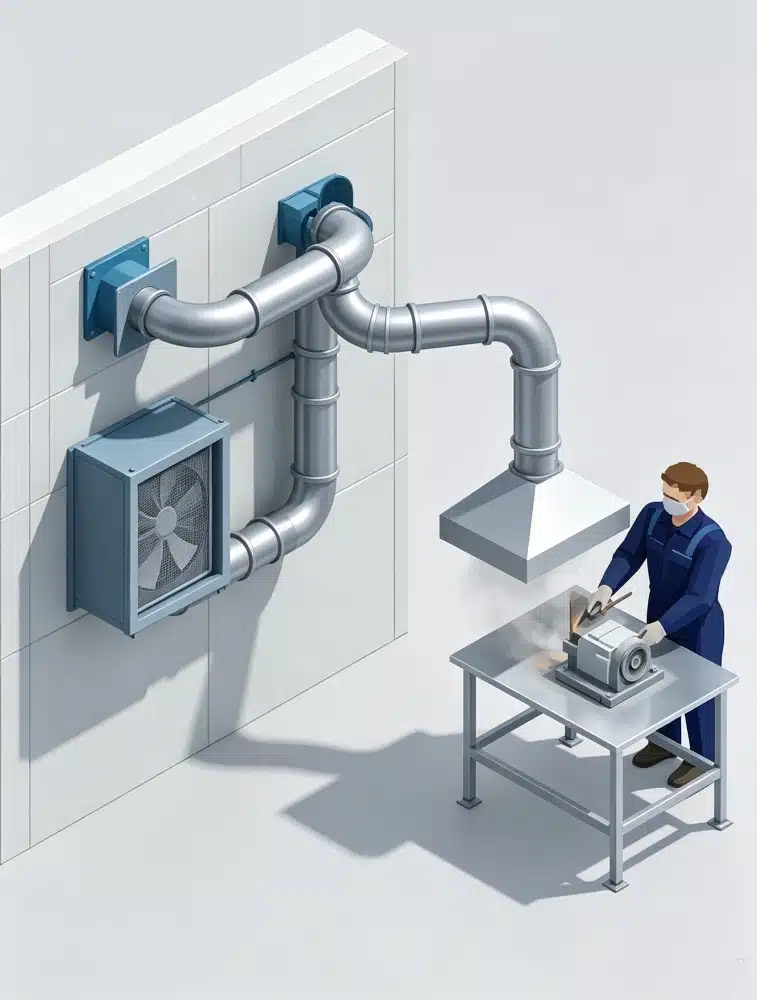
Not every ventilation challenge is identical. While negative-pressure exhaust fans are ideal for removing hot, humid, or stale air from large spaces like factories and warehouses, certain processes require a more targeted approach. Local Exhaust Ventilation (LEV) systems are designed to capture contaminants such as welding fumes, mist, smoke, or dust at their source, preventing them from spreading throughout the workspace.
Not Sure Which Product You Need?
Explore our range of industrial cooling and ventilation solutions tailored to meet your specific needs. Whether you’re looking to improve air quality, enhance cooling efficiency, or ensure optimal airflow, we have the right solution for you.
Need to Remove Hot or Stale Air?
Our Negative Pressure Exhaust Fans are designed to efficiently expel hot or stale air, ensuring a fresh and comfortable environment. Ideal for factories, warehouses, and agricultural settings.
Need to Move Air Around a Large Space?
Air Circulation Fans are perfect for distributing air evenly across large areas, enhancing ventilation and maintaining a consistent temperature throughout your facility.
Need Portable, Directional Airflow?
Our Industrial & Commercial Drum / Barrel Fans provide powerful, directional airflow that can be easily moved to where it’s needed most, offering flexibility and convenience.
Need Fresh-Air Evaporative Cooling?
Evaporative Cooling Systems offer an energy-efficient solution for cooling large spaces by utilizing the natural process of evaporation to lower temperatures and improve air quality.
Need Refrigerated Cooling?
Industrial & Commercial Air Conditioners deliver robust cooling solutions for spaces requiring precise temperature control, ensuring optimal conditions for your operations.